
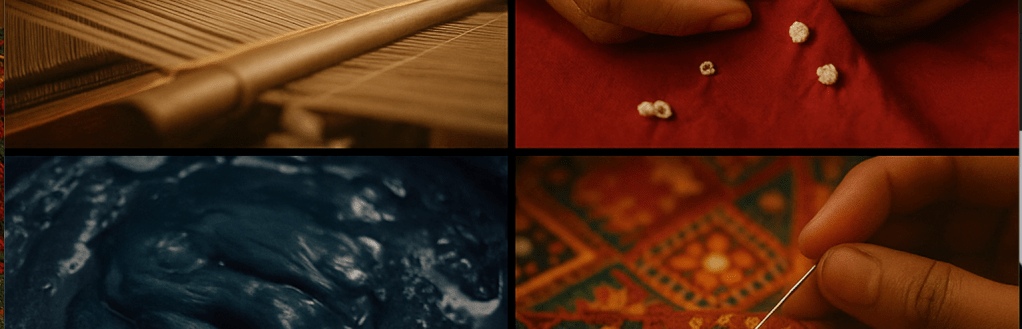

There is a moment in every well-woven sari, a stitch in every bold print, a tone in every dyed fabric, when we thread backward: to elders, to earth, to ritual. Textiles in India are not merely cloth—they are carriers of belonging, of stories spun through warp and weft, pigment and hand, form and belief.ms, the Hands, the Soul
The Looms, the Hands, the Soul
Long before “fashion” as a word existed, there were looms in angans, ruanas over shoulders, odhnis floating in monsoon air. Weavers and dyers were keepers of plant knowledge, of soil-colours, of religious symbolism, of social identity. Whether an adivasi in Kutch embroidering a cosmos of mirrors, or a master artisan in Andhra applying a kalam to narrate epic tales, every thread connects to place and person.
Dyes: Earth’s Palette & Ritual Ink
Natural dyes—indigo, turmeric, madder, myrobalan—once shaped how colour moved over skin, over ceremony. In dyeing, rituals unfold: the mordant (fixative) that makes pigment permanent; the repeated washes; the sun-bleaching; the understanding that colour has to be coaxed, not forced. Colour isn’t just seen—it’s lived.
Prints & Resist: Stories in Shade and Shape
Techniques like Bandhani (tie-dye), Leheriya, Kalamkari, and Madurai Sungudi are more than print styles. They are maps of cultural respect, cosmology, seasonal change, and social role.

- Bandhani: patterns evoking fertility, rain, ritual marking.
- Leheriya: wave-like designs reflecting the desert wind in Rajasthan.
- Kalamkari: myth on cloth, epic tales hand-drawn or block-printed.
Embroidery: The Textile Memory

“Each motif carries the handprint of generations.“
Embroidery in India is rich and manifold:
- Phulkari (Punjab): geometry and florals in bright thread.
- Kantha (Bengal/Odisha): running stitches on layered saris, motifs of daily life.
- Kutch Embroidery: mirrors, borders, celestial patterns.
- Zardozi: gold, silver, pearls—once reserved for royalty.
What Has Changed — What Remains
Modernity, migration, synthetic dyes—all have touched these crafts. Some adapt, some vanish, some persist through mother-to-daughter transmission, revivalist circles, conscious clothing.
At the heart is intentionality: choosing a fabric, wearing it, preserving it. A blouse stitched by hand carries the pulse of the maker. A printed scarf holds flora, belief, and lineage. Even everyday cotton becomes treasuring when its origin is known.
Why We Begin Here
Because in this first post of Threads & Traditions, we root our conversation in depth before style. Cloth is not just worn—it is inherited, hoped, performed, remembered. Every print, dye, motif is culture, ritual, identity.
In the months ahead, we will:
- Explore specific crafts one by one.
- Meet weavers and dyers.
- Sit with pigment.
- Document stories
Reflections for You
- The next time you fold a sari or wrap a dupatta, look at the motifs. Ask: whose eye saw them first?
- When you choose colour—turmeric yellow, indigo blue, red madder—remember they are gifts from earth.
- Let every stitch you admire be a bridge: between artisan and wearer, past and now.
In gratitude to the hands that teach, to the threads that endure,
— Sutra by LR
 Sutra by LR
Leave a comment