
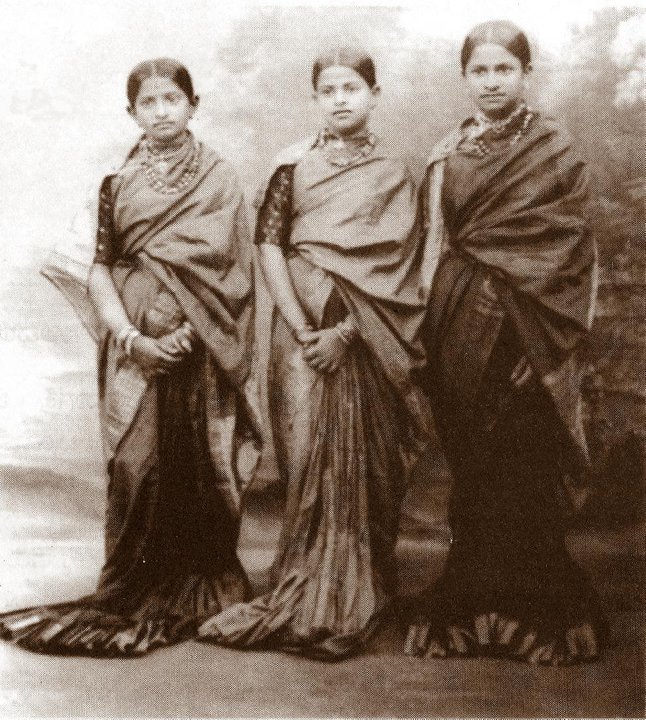
In a world obsessed with what’s next, the saree asks a different question: What if the future has been here all along?
Name one other garment that’s been in continuous style for 5,000 years. One piece of clothing that traveled from the Indus Valley to Instagram without losing its essence. One cloth that fits everybody, every occasion, every identity, without changing its form.
I’ll wait.
Fashion’s Only Time Traveller
The saree doesn’t just survive fashion trends. It is fashion – constantly, eternally, impossibly. While hemlines rise and fall, while silhouettes come and go, while entire aesthetics are born and buried within a decade, the saree simply exists. Unchanged. Uncompromising. Unstitched.
How does a garment travel through time like this? How does it go from ancient ritual to boardroom power to wedding heirloom to Sunday brunch without an identity crisis?
The answer is deceptively simple: the saree never pretended to be one thing.
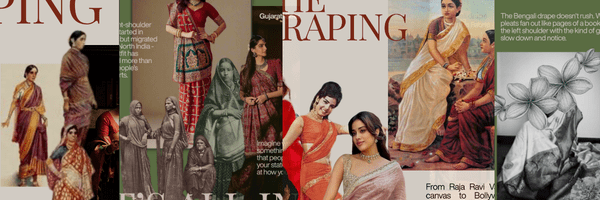
When you talk about the “style” of a saree – Nauvari, Bengali, Gujarati pallu, Coorgi – you’re still talking about the same 6 yards of cloth. No cutting. No alteration. Just draping. The garment doesn’t change. You do. And the saree changes with you.
Beyond Geography’s Borders
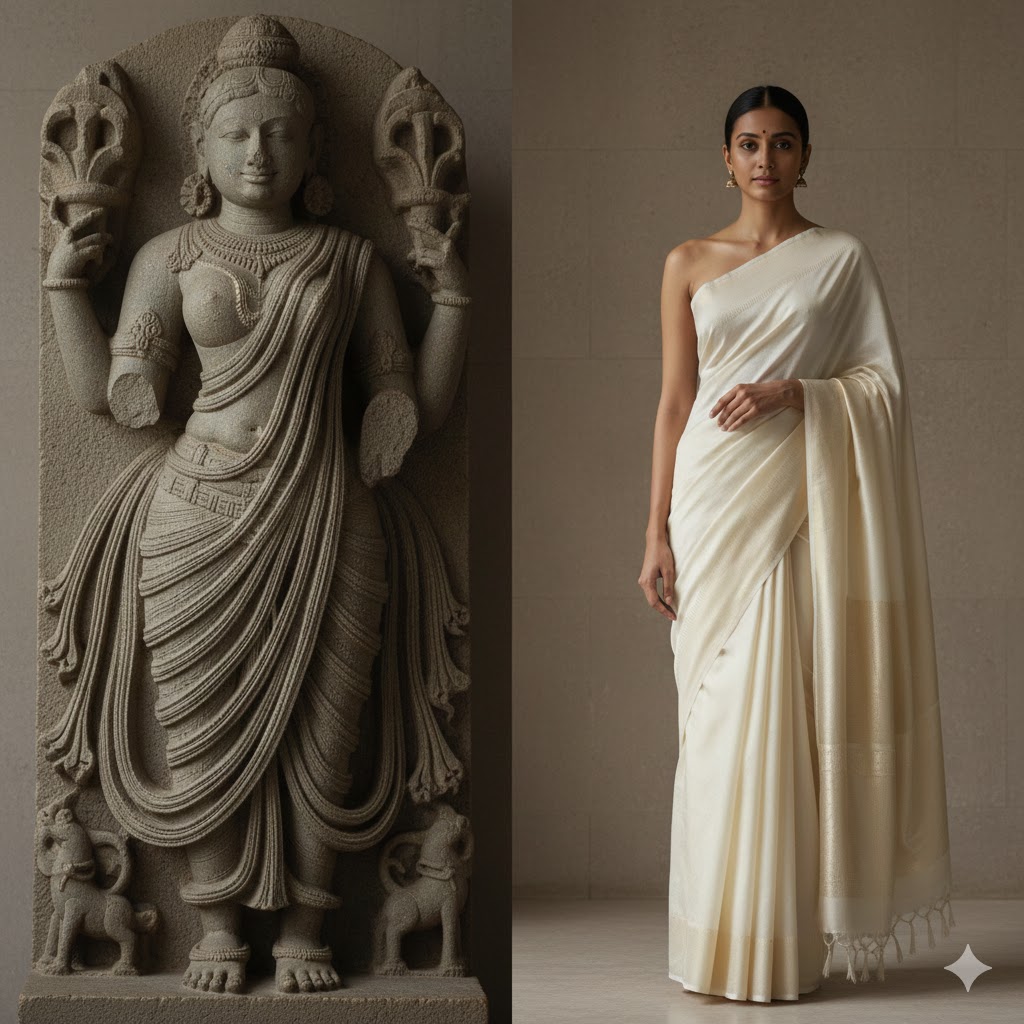
The saree doesn’t belong to one place. It belongs to everywhere, and looks different in each.
Drape it in Maharashtra, and suddenly you’re wearing nine yards with pleats tucked at the back. The Nauvari, designed for women who needed to move. To work the land. To fight if necessary. To climb, to run, to live without restriction.
Drape it in Gujarat, and the pallu shifts to your right shoulder instead of left. The Seedha Pallu, a geographic signature so specific that people can guess your region just by watching how the fabric falls.
Drape it in Bengal, and the pleats widen into deliberate box folds, each one breathing space instead of stacking tight. A drape that moves like poetry: unhurried, flowing, intentional.
Drape it in Coorg, and the pleats migrate to the back, the pallu wrapping around your body before coming over your shoulder. Mountain practicality woven into tradition. A drape engineered for hilly terrain.
Same six yards. Different fold. Different geography. Different identity.
The saree doesn’t just cross state borders. It becomes the border, a cultural GPS you wear. Your drape tells me where you’re from before you say a word.
One cloth. Infinite regional stories.
Memory, Woven
Saree’s most radical quality isn’t its adaptability or its timelessness. It’s this: the saree is memory.
My grandmother’s sarees are still in my closet. Not as costume pieces. Not as “vintage finds.” As living garments that carry her scent, her stories, her hands pleating the fabric the same way I pleat mine now.
Fashion is supposed to die. Trends expire. Clothing gets donated, discarded, replaced.
But the saree? The saree endures. It passes down. It witnesses generations. It becomes more valuable with age, not less.
Cultural significance speaks through each unique design – regional motifs, weaving techniques, dyeing traditions passed down through centuries. But it dives even deeper within families. That wedding saree your mother wore. The everyday cotton your grandmother tied while making breakfast. The silk your aunt saved for special occasions.
These aren’t just clothes. They’re inheritance. They’re archive. They’re proof that you come from somewhere.
What Survives, Survives for a Reason
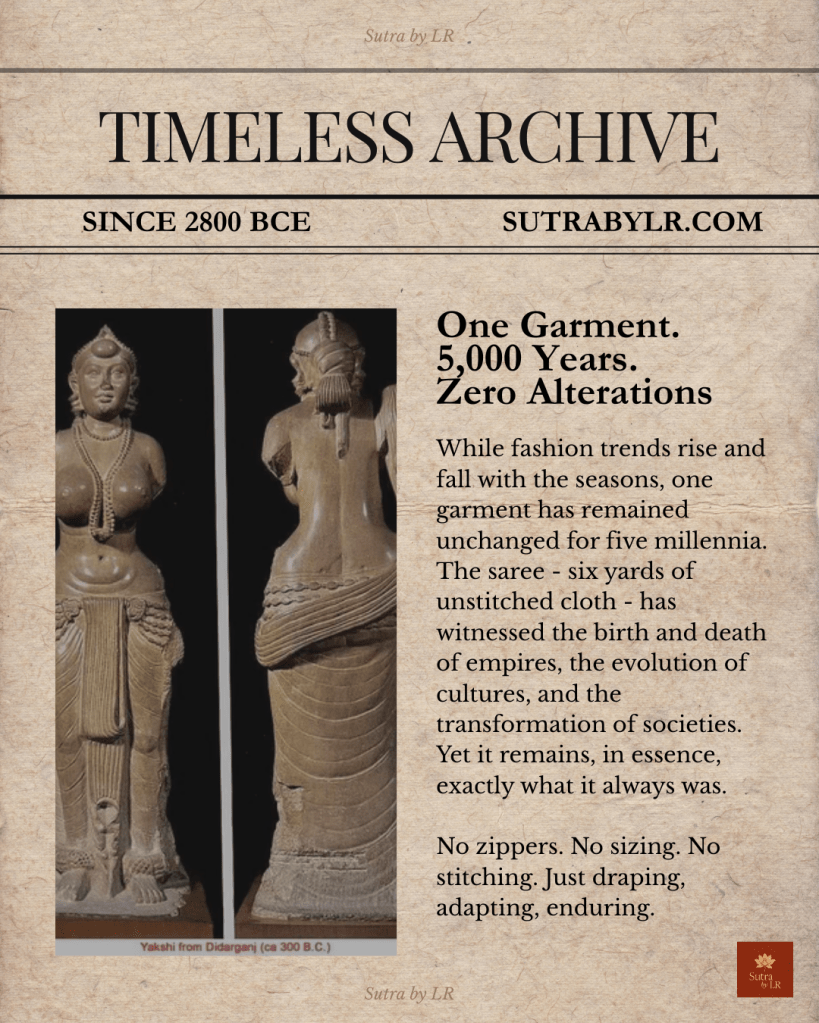
The history of the saree has depth – from Vedic texts to archaeological findings, from sacred unstitched cloth to symbol of identity. But the real miracle isn’t that it’s ancient.
The miracle is that it’s still fashion.
Not “traditional wear.” Not “ethnic costume.” Fashion. Present-tense. Living. Evolving without losing itself.
The saree survived colonialism, globalization, fast fashion, and every trend cycle that tried to make it irrelevant. It survived because it was never trying to be permanent. It was trying to be true.
And maybe that’s the lesson we keep missing. Fashion isn’t about what’s next. It’s about what endures. What adapts. What holds memory while making space for change.
The saree has been doing this for 5,000 years.
 Sutra by LR
Leave a comment